|
In General, play is about
equal in the mornings and the afternoons. When this applies, the long
axis of a tennis court should be oriented true North South (non magnetic).
This minimizes the adverse effect of one player looking directly into
sun.
However, say a substantial
volume of play takes place in the afternoons, while there is a very little
play in the mornings. In this case, it may be advantageous to orient the
court in the North-East and South-West direction. This avoids a player
on the south side having to face directly into the sun (southern hemisphere
only).
It is recommended that
the maximum deviation from true north be not more than 15 degrees.
Tables and diagrams giving
sun elevations and directions for various times of the day, during different
seasons of the year, at various latitudes, are available at most libraries.
Such Sun-azimuth elevation tables should be studied carefully before tennis
court is oriented more than few degrees away from the true North-South
directions.
A tennis court must be
a true plan. Slop of 1” 10’ should be from east to west or
from west to east, depending on the available drainage system in the neighborhood.
General
Principal
Sub
Surface Drainage:
A peripheral sub surface drainage system must be installed when needed
to intercept and redirect to flow of sub surface water that might otherwise
accumulate beneath court areas. Where it is necessary to lower the water
table at a given site, a sub surface lateral or parallel drainage system
may be required to direct free water from the sub surface to other areas.
Surface Drainage: A series
of swales must be designed where needed, to direct surface water that
might otherwise flow over the surface and to prevent seepage of water
beneath the surface.
Bituman grade 80/100 by
WT 6% should be used. All materials should be of best quality and correct
size. Use sieve for elimination over size mental especially for second
layer. Seal coat of 6 mm premix material should be provided over the asphalt
concrete, so as to protect the asphalt concrete surface from damage while
in use during monsoon, and before the final deco turf is laid after the
monsoon.
A drainage trench 1’
– 0” to 2’ – 0” wide shall be dug on the
full or partial perimeter of the facility as dictated by local conditions.
The trench shall have minimum depth of eighteen inches (18”) but
not less than full depth of the constructed foundation.
Two inches (2”) to
four inches (4”) of a permeable aggregate shall be placed on the
base of the trench.
A porous or perforated
pipe with a minimum diameter of four inches (4”) shall be placed
on the aggregate in such a way as to have not less than one inch (1”)
in thirty feet (30’) of pitch and not more than one inch (1”)
in ten feet (10’) of pitch. A larger pipe may be required as dictated
by the amount of free water to be conveyed or available pitch on the pipe.
A porous membrane or other
porous cover may be placed over the drainage pipe to prevent infiltration
of ground silt or other materials into drainage system. This will depend
on the type of aggregate available or used.
Back fill of the trenches
shall be of permeable aggregate of no large than one and half inches (1
½ “) placed in six inches (6”) lifts, each of which
shall be compacted to minimize the risk of subsequent settlement.
The trench shall be filled
at the surface with smaller washed stone where an open drain is desirable.
Where a closed drain is
called for, the trench shall be filled to eight inches (8”) below
the surface, after which a porous type membrane may be placed over the
stone, and a sod or an impervious type swale formed over this.
The free water “spill
off” from the drainage system shall be directed to avoid complications
to surroundings area. Local building and/or zoning codes may require dry
wells large enough to retain approximately one half inch (1/2”)
to one inch (1”) of rain water falling on the surface area in one
hour. Consult with local authorities having jurisdiction. A pipe having
an open discharge should be protected with a head wall for easy identification,
and covered with coarse screening to prevent small animals from entering
and clogging the drainage system.
When installing sub surface
drainage under existing tennis courts, it is important that the granular
or washed on material backfilled to achieve 100% density factor. This
procedure will reduce the amount of surface settlement and reflection
of this settlement. When using this procedure, it is recommended to contact
or consult a qualified architect and/or engineer.
The greatest single factor
is the deterioration of tennis court surface is the presence of free water
beneath surface. Proper pitch and consistency of grade in the sub surface
system are essential.
Proper and consistent pitch
to the sub grade and in the sub base is frequently underestimated. Correct
pitch is essential to avoid “Pockets” that might hold free
water, thereby negating an otherwise good drainage system.
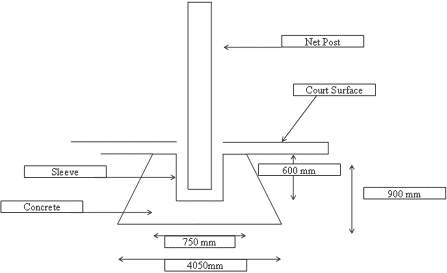
Netposts
and Netpost Foundations:
Netposts should posses the following properties-
-
The Netpost should remain upright
and should not tilt towards the centre of the net over the entire
life of the surface.
-
Netposts may be circular or square
in cross sections. In either case, Netposts should be easily removable
from the sleeve in the Netpost foundation to allow annual maintenance.
-
It must be possible to maintain the
winding mechanism of the net so that it will not become inoperable
due to rust, stress etc. Annual cleaning and lubricating maintenance
is recommended.
The strength of the Netpost
foundations required to ensure that the net fulfils the above requirements
obviously depends on the foundation characteristics. Experience over the
years has led us to adopt a standard Netpost footing which will fulfill
the requirements, irrespective of the quality of foundation and soil.
If the foundations, base etc will support a tennis court surface, then
providing reasonable quality concrete is used, the Netpost footing shown
in figure below, will provide the necessary strength to support the above
requirement of zero tilt over the life of the court surface.
|